
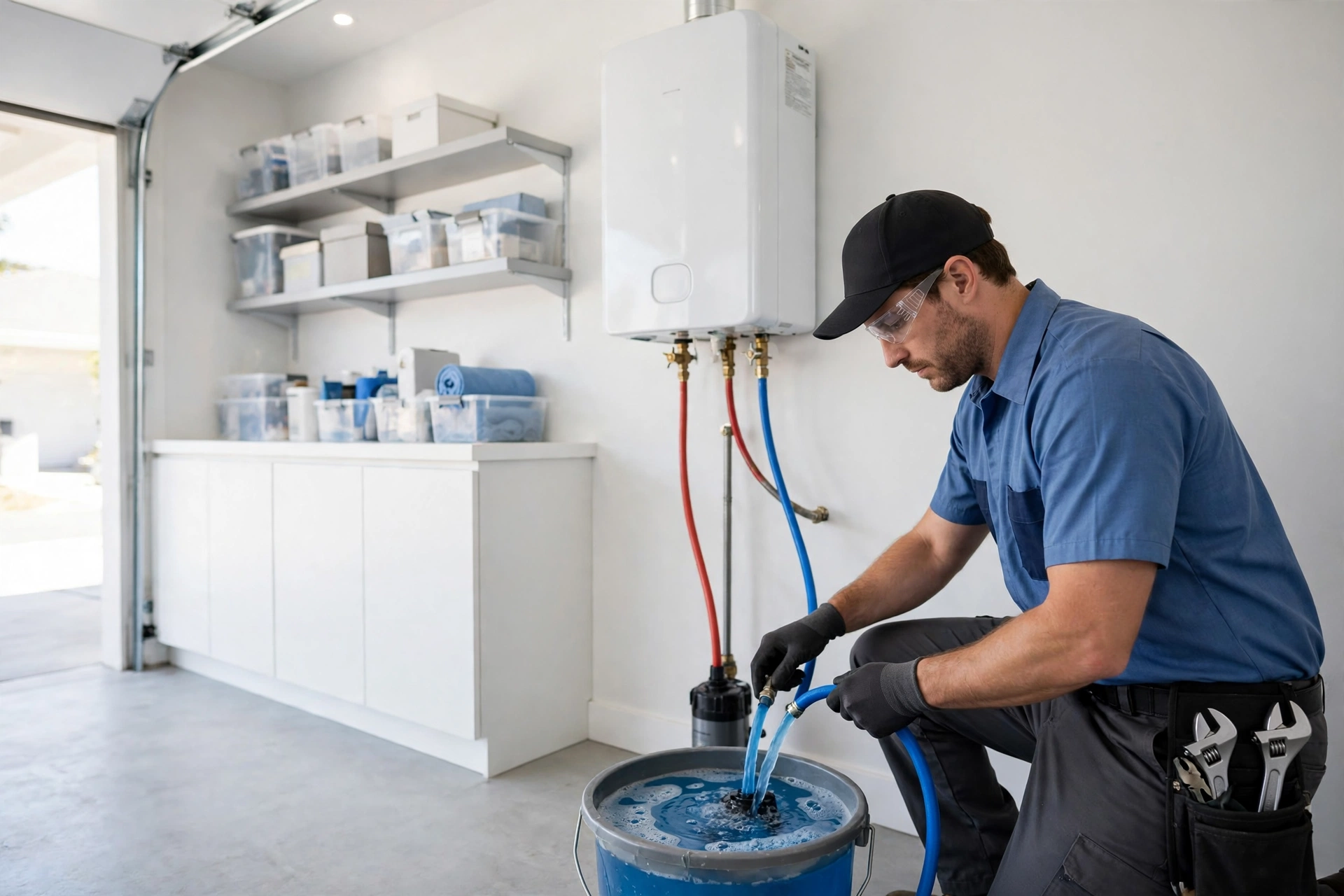
A tankless water heater flush — a descale — removes the mineral scale that builds up inside the heat exchanger and makes the water run lukewarm. It is the most-requested service on this site, and the one with the strongest record behind it: of the tankless calls tracked in our demand research, flush and descale requests were the most likely to turn into a booked, paid job.
Scale is simple chemistry. Every gallon of hard water carries dissolved calcium and magnesium. Inside a tankless heat exchanger, the water is heated fast and the minerals drop out, coating the inside of the exchanger with a layer of scale. That layer insulates the water from the heat. The unit works harder, the water gets cooler, and eventually the unit overheats and shuts itself down. A flush dissolves that layer and gives the heat exchanger back its surface.
Signs your unit needs a flush
- Lukewarm water. The water starts hot and fades, or never gets properly hot.
- A dropping flow rate. Less water coming out of the tap than there used to be.
- An over-temperature code. Rinnai 14 or 16, Navien E016, Noritz 16 — the unit is overheating because scale is insulating the exchanger.
- A maintenance reminder. Navien's W003, and similar reminders on other brands, is the unit asking for a flush.
- Rumbling or kettling. The sound of water boiling against a scaled surface.
- It has never been flushed. In a hard-water city, two years without a flush is enough for real buildup.
How a flush works
- Shut it down. The unit is turned off and the water supply is isolated, so the flush runs through the heat exchanger and nowhere else.
- Connect the pump. Hoses are connected to the unit's service valves, and a small pump circulates descaling solution through the heat exchanger.
- Circulate the solution. The solution runs through the exchanger until the scale has dissolved — the time depends on how bad the buildup is.
- Flush with clean water. The solution is drained and the unit is flushed with clean water until it runs clear.
- Check and test. The inlet filter is cleaned, the sensors are checked, and the unit runs a full hot-water cycle to confirm the temperature holds.
How often to flush — it depends on your water
In hard-water cities, once a year is the usual rhythm. Casper, Wyoming runs about 19 grains per gallon; Janesville, Wisconsin about 20; Fond du Lac County around 19. At that level, a year of scale is enough to matter. In soft-water cities — Medford, Oregon at 20 to 40 parts per million, Longview, Texas at 55 to 68 milligrams per liter — every two years is often enough. Your city page on this site states the local hardness, so you can see where your home falls.
The maintenance reminder is the honest guide. If the unit is asking for a flush, it is not selling you anything — it is counting the hours since the last one and telling you the exchanger needs attention.
What affects the cost of a flush
How bad the scale is matters most — a lightly scaled unit flushes quickly, a badly scaled one takes longer and may need a second pass. Whether the visit is a flush alone or a flush plus a repair matters too, because a unit that is being flushed and fixed in the same visit is one trip, not two. The city matters, because the water decides how often the job needs doing. This site does not publish prices; the provider sets the price once the unit has been seen.
Questions people ask
How much is a descale?
It depends on the city and the unit — how bad the scale is, and whether the visit is a flush alone or a flush plus a repair. This site does not publish prices because no two units are the same. Call (877) 418-1589 and describe the unit; the provider sets the price once the unit has been seen.
How do I know my tankless water heater needs a flush?
Lukewarm water, a flow rate that keeps dropping, an over-temperature error code, or a maintenance reminder on the display. In a hard-water city, a unit that has never been flushed will show one of these within a couple of years.
Can I flush a tankless water heater myself?
Some homeowners do, with a pump, hoses and a descaling solution. It is a maintenance job, not a repair, and plenty of people do it themselves. The reason to have a provider do it is that they check the unit at the same time — the filter, the sensors, the venting — and catch the fault that a flush alone would not fix.
How often should a tankless water heater be flushed?
In hard-water cities, once a year. In soft-water cities, every two years is often enough. The maintenance reminder on many units — Navien's W003, for example — is the unit asking for a flush, and it is worth listening to.
Related pages
In your city
Start with a call
Describe the symptom — no hot water, an error code, lukewarm water, or a leak — and an independent local provider takes it from there.
Hot water out? Call now.
One call connects you with an independent local tankless provider. Describe the symptom — the rest is the visit.