
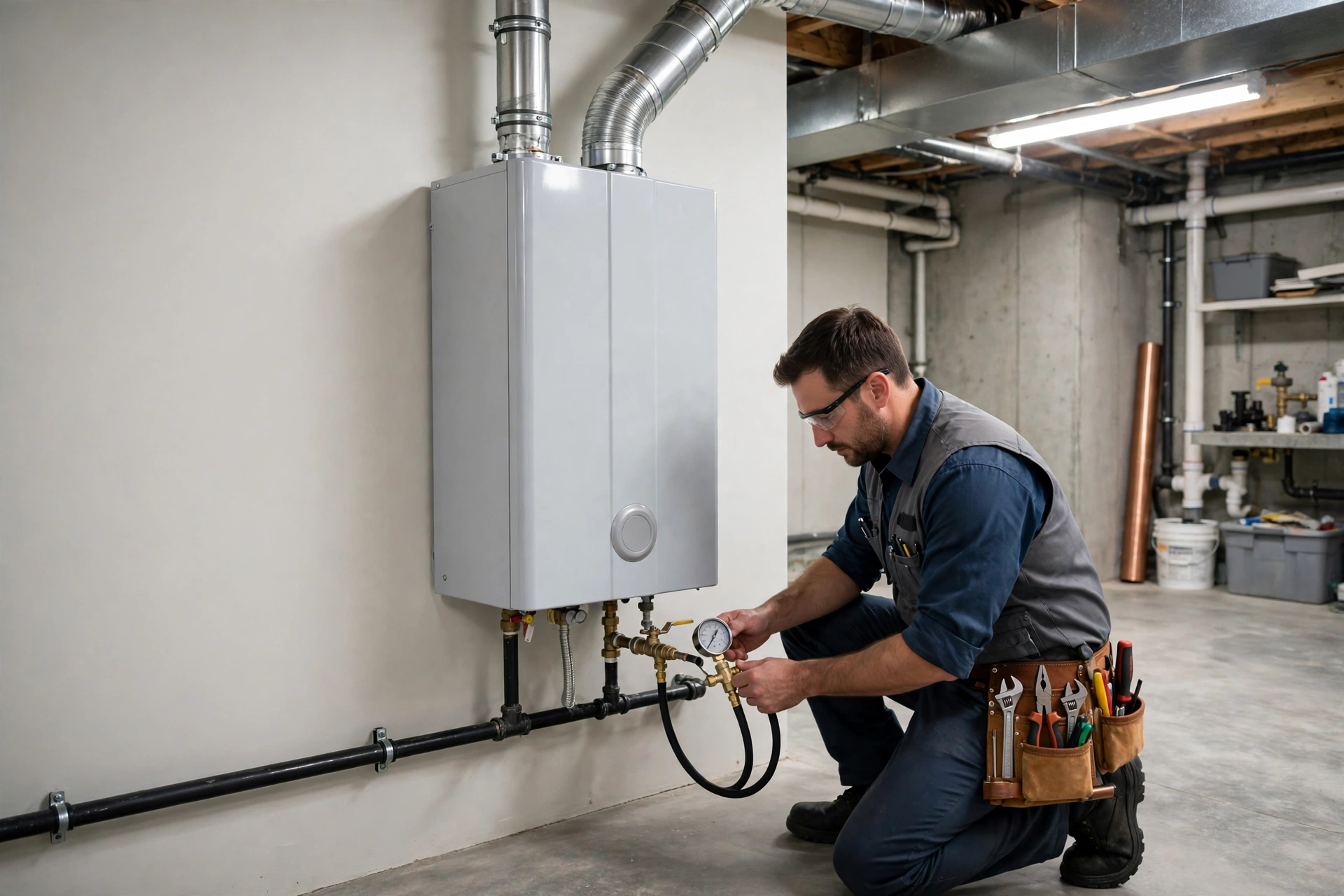
A gas tankless water heater repair deals with the gas side of the unit: ignition, the gas valve, the flame sensor, and the venting that carries exhaust out of the house. When a gas unit fails, it usually fails at one of those four points — and the symptom tells you which one.
Gas tankless units are the most common kind in the South and West, where natural gas is cheap and houses are built around it. They heat water with a burner, like a small furnace, and they need three things to work: gas at the right pressure, air for combustion, and a clear path for the exhaust. Take away any one of them and the unit stops — usually with an error code on the display.
Signs your gas tankless unit needs repair
- It will not ignite. The burner never lights, or it clicks and gives up.
- It lights, then goes out. Flame loss during operation, often a sensor or gas pressure problem.
- An error code. Rinnai 11 or 12, Navien E003 or E012, Noritz 11 or 12, Rheem 11 or 12 — all ignition and flame codes.
- A gas smell. Leave the area and call your gas utility's emergency line from outside. Do not wait.
- Yellow or lazy flame. A burner that should burn blue and steady.
- Soot around the vent. A sign the unit is not burning cleanly.
How a gas repair visit works
- The call. Describe the symptom and the code on the display. Mention the brand if you know it.
- The gas check. Gas valve open, gas pressure in range, other gas appliances working.
- The ignition check. Igniter, flame sensor and burner — cleaned or tested, not guessed at.
- The venting check. Intake and exhaust clear, no blockage, no bird nest, no ice.
- The fix and the test. The faulty part is replaced or cleaned, and the unit runs a full hot-water cycle before the provider leaves.
What affects the cost of a gas repair
The part is the biggest factor — an igniter or a flame sensor costs less than a gas valve, and a gas valve costs less than a control board. Venting matters too: a blocked or wrongly routed vent can turn a small repair into a bigger job. Scale matters on gas units just as much as on electric ones, because a scaled heat exchanger overheats and trips the unit. And the age of the unit matters — parts for older models can be harder to find.
Gas safety, plainly
A gas tankless unit is safe when it is working properly, and it is not a thing to open up yourself. If you smell gas, leave the house, do not touch any switch, and call your gas utility's emergency line from outside. If the unit shows a combustion error — Rinnai 13, Noritz 90 or 99, Rheem 13 — stop using it and call. Those codes mean the burner is not burning cleanly, and that is a provider's job, not a homeowner's.
Questions people ask
My gas tankless water heater will not ignite. What is wrong?
Usually the gas supply, the igniter, or the flame sensor. Check that the gas valve is fully open and that other gas appliances work. If the gas is on and the unit still will not light, the igniter or the flame sensor is the next thing a provider checks.
I smell gas near my water heater. What should I do?
Leave the area, do not switch anything electrical on or off, and call your gas utility's emergency line from outside. A gas smell is the one tankless symptom that is never a wait-and-see problem.
Why does my gas tankless unit keep shutting off?
Flame loss during operation usually means a gas pressure problem, a dirty flame sensor, or a venting fault. The unit lights, runs for a while, then loses the flame and locks out. It is a fault that needs a look, not repeated resets.
Does altitude affect a gas tankless water heater?
It can. At high altitude the air is thinner, and some gas units need a different setup to burn cleanly. It is a setup question for the provider, not something to adjust yourself.
Related pages
In your city
Start with a call
Describe the symptom — no hot water, an error code, lukewarm water, or a leak — and an independent local provider takes it from there.
Hot water out? Call now.
One call connects you with an independent local tankless provider. Describe the symptom — the rest is the visit.